

Managing IT for a multi-location team is difficult at the best of times, and introducing outages into the mix makes it significantly worse. Troubleshooting becomes tricky when IT staff cannot directly see the error message or glitch, potentially leaving problems unresolved. The long-term consequences on your business can be dire: extended downtime, reduced profits, and even data breaches.
But there is hope. Remote IT support companies offer one solution, helping small businesses across the globe fill staffing gaps and address the challenges of a multi-location workplace. Understanding how these services work, and the benefits they provide, can vastly improve productivity and collaboration for your entire team.
Why In-House Remote IT Support is Unrealistic
Your in-house support team may be sufficient for on-site staff, but multi-location work introduces a whole new set of challenges that make it far more difficult. Internal teams supporting remote environments often face:
- Inconsistent hardware setups
- Varying network capabilities
- Different policies for remote vs in-office use of technology
These disparities can make remote issue resolution a frustrating and time-consuming process, increasing the risk of errors.
In some cases, it may not even be possible to fix the problem with your current team’s available resources. Small businesses rarely put together an IT department with remote work in mind, often only having one or two employees who may not be experienced with multi-location support or have the necessary tools. In this case, the issue simply goes unresolved – potentially leading to much bigger disruptions later on.
There is also a significant security risk involved. A distributed workforce requires strong data management practices across multiple locations with varying levels of protection. If one link in this long and complex chain is not secured properly, the entire business is put at risk. These factors make it all but impossible for a small, internal team to effectively manage your company’s IT support needs.
How Outsourcing Keeps Your Technology Running Smoothly
Remote IT support companies (sometimes referred to as managed service providers, or MSPs) are experts in their field, with years of experience behind them and tools that most small businesses could only dream of. They understand the unique difficulties associated with a dispersed workforce, and are prepared to meet them head-on.
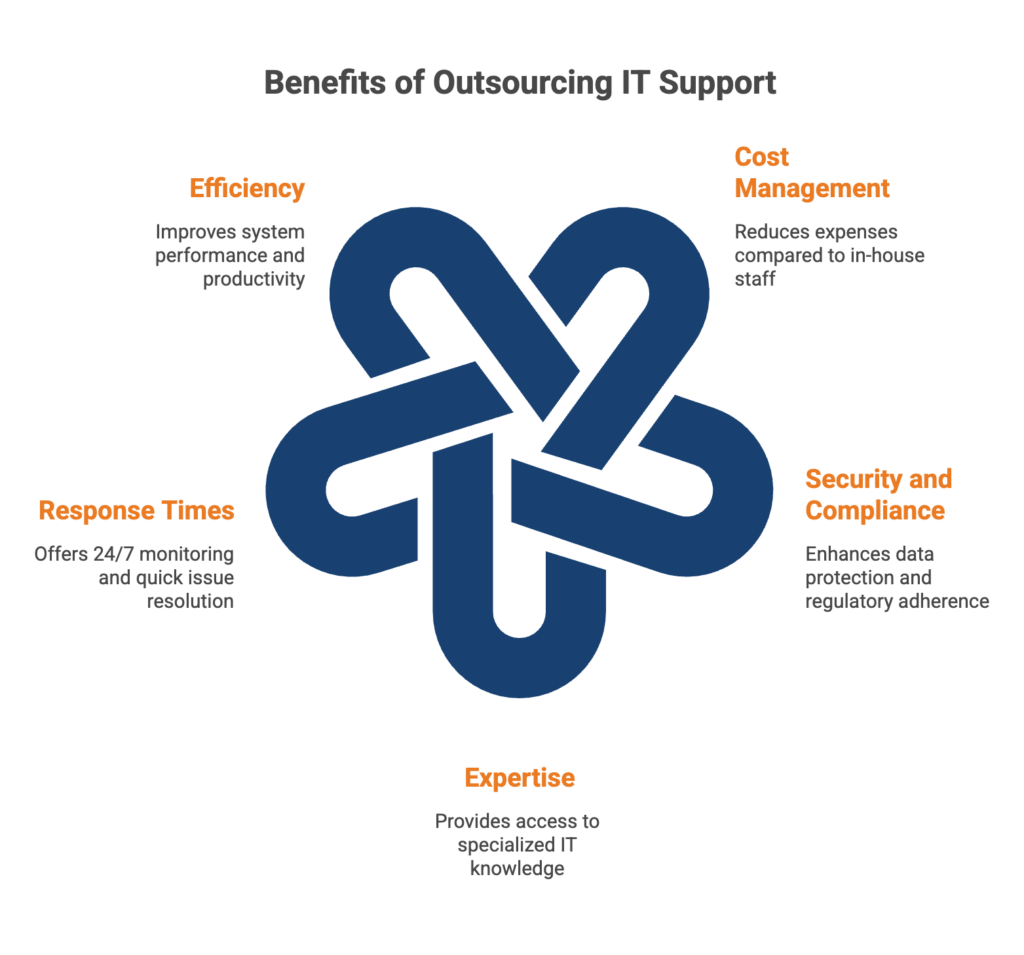
Remote IT support provides a wide range of benefits over relying on your in-house employees:
- More Effective Cost Management: Outsourced IT services rarely cost as much as internal staffing. This is because they use economies of scale, allowing them to offer their expertise at a much lower price point. You are also not liable for additional costs such as benefits or training. All you pay is a monthly fee, making this option significantly cheaper than expanding your team.
- Better Security and Compliance: MSPs understand how to secure a remote workplace and compensate for the additional vulnerabilities it introduces. They help ensure that data protection policies are followed consistently across all locations, maintaining compliance and reducing your risk of experiencing a breach.
- Additional Expertise: Outsourcing provides you with access to a variety of IT experts, each with their own areas of specialization.This allows you to cover gaps in your in-house team’s knowledge, without needing extra staff.
- Shorter Response Times: Internal teams can only address technical issues during working hours – but not every problem appears from 9 – 5. Many MSPs work 24/7 to monitor your systems, detecting them quickly. And because they are remote, you don’t have to wait for them to show up on-site. The issue is solved quickly, reducing downtime and strengthening continuity.
- Improved Efficiency: The right support team won’t just fix issues. They will monitor your systems at all times, identify inefficiencies, and suggest improvements. Over time this not only reduces outages, but will actually make your business more productive than it was before.
Learn how to improve efficiency and cost management in your law firm
The Challenges of Working With Remote IT Support Companies (and How to Solve Them)
While outsourced remote IT support benefits your business in many ways, this model still brings challenges of its own:
- The Learning Curve: Third-party support services might not be familiar with your business straight away, resulting in errors and wasted time while they learn about your needs.
- Miscommunications: Whenever you outsource a task, communication becomes imperative. Issues in this area can undermine the effectiveness of your partnership.
- The Issues Remote Technical Support Can’t Solve: Not every issue can be fixed over a phone call or virtual meeting. Sometimes, workers need to be on-site to solve the problem.
The best way to avoid running into these challenges is by choosing the right provider. There are many available, and not all of them will suit your company. Pay attention to your first conversation, as this can tell you a lot about how they operate. Do they ask questions about your business, or immediately leap in with solutions that may not work for you? Are they able to explain highly technical concepts in a way someone with no IT background could understand? Do they respond to questions quickly, accurately, and with full transparency?
If all of these elements are in place, you likely have a good MSP on your hands. The right partner will need to walk team members through on-site fixes, develop tailored solutions on the fly, and respond immediately when something goes wrong. Look for a remote IT support company that has this skill set, and you’re far less likely to experience problems.
Remote IT Support Tools: Best Practices
Another good question to ask is about their remote IT support software solutions. Remote access software is often used to access a user’s device from a distance, allowing experts to solve problems that require more direct control. However, it can create a security risk when not utilized correctly. Ensure that:
- There are clear policies around when and how remote IT support tools can be used.
- The software used explicitly requires permission from the user before handing over control to a third party.
- Staff are notified each time that these tools will be used, in advance.
- You have internal policies in place to protect sensitive data and accounts – for example, sensitive information may not be accessed while remote IT support software is in use.
Ensure Efficiency and Security Without Sacrificing Work-Life Balance
Running a multi-location team without expert IT support is a game of chance. Things might work perfectly for a while, but when they don’t, the consequences will be far worse. Good remote IT support will not only keep your business running, but actually make it better by improving poor processes and introducing modern support solutions. For smaller companies without a large internal team, this can be the perfect path moving forward.
As a leading provider of IT and print solutions, Com Pro has the expertise you need to manage a distributed workforce safely and efficiently. If you want to offer staff a better work-life balance but are nervous about IT, discover some essential tools for stronger remote work.